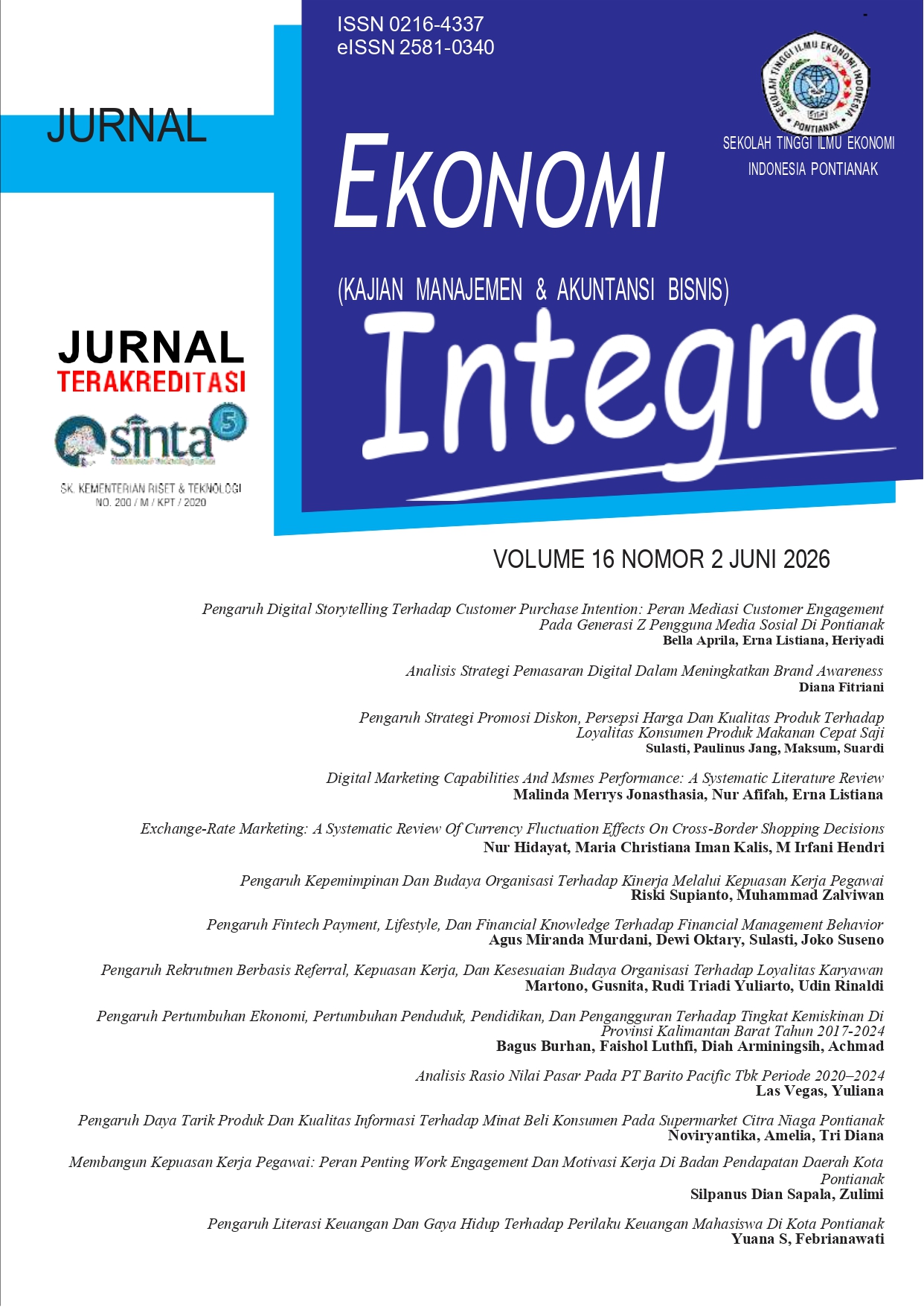
PENGARUH DIGITAL STORYTELLING TERHADAP CUSTOMER PURCHASE INTENTION: PERAN MEDIASI CUSTOMER ENGAGEMENT PADA GENERASI Z PENGGUNA MEDIA SOSIAL DI PONTIANAK
DOI:
https://doi.org/10.51195/iga.v16i2.107Keywords:
Digital Storytelling, Customer Engagement, Customer Purchase Intention, Generasi Z, Media SosialAbstract
Penelitian ini mengkaji pengaruh digital storytelling terhadap customer purchase intention dengan customer engagement sebagai variabel mediasi pada generasi Z pengguna media sosial di Pontianak. Generasi Z, sebagai digital natives, menunjukkan pola konsumsi yang unik dan responsif terhadap konten digital yang menarik dan bercerita. Digital storytelling telah menjadi strategi pemasaran yang semakin penting dalam membangun koneksi emosional dengan konsumen dan mendorong keputusan pembelian. Penelitian ini menggunakan pendekatan kuantitatif dengan metode structural equation modeling berbasis variance menggunakan Partial Least Squares. Sampel penelitian terdiri dari responden generasi Z yang aktif menggunakan media sosial di Pontianak, dipilih melalui purposive sampling. Data dikumpulkan melalui kuesioner terstruktur dengan skala Likert. Hasil penelitian menunjukkan bahwa digital storytelling berpengaruh sangat kuat terhadap customer engagement, customer engagement berpengaruh signifikan terhadap customer purchase intention, dan digital storytelling berpengaruh signifikan terhadap customer purchase intention secara langsung. Analisis mediasi menunjukkan bahwa customer engagement memediasi sebagian besar dari total pengaruh digital storytelling terhadap purchase intention. Model penelitian memiliki daya eksplorasi yang substantial terhadap variance dalam customer engagement dan purchase intention. Temuan ini memiliki implikasi praktis bagi perusahaan dalam mengembangkan strategi content marketing yang lebih efektif melalui pemanfaatan digital storytelling untuk meningkatkan engagement dan pada akhirnya mendorong purchase intention di kalangan generasi Z
References
Admara, K. W., & Indrawati. (2025). Impact of social media marketing on purchase intention via brand awareness, trust, and engagement: Evidence from The Originote on TikTok. Quality - Access to Success, 26(208), 388–393. https://doi.org/10.47750/QAS/26.208.40
Andika, Najmudin, M., Nasution, A. A., Anisah, T. N., Luthfiana, D. N., & Nadia. (2025). Enhancing impulse buying among Generation Z through social presence in e-commerce live streaming. TEM Journal, 14(1), 236–250. https://doi.org/10.18421/TEM141-22
Ao, L., Bansal, R., Pruthi, N., & Khaskheli, M. B. (2023). Impact of social media influencers on customer engagement and purchase intention: A meta-analysis. Sustainability (Switzerland), 15(3), Article 2744. https://doi.org/10.3390/su15032744
Ateş, A., Sunar, H., & Erdem, B. (2024). The Generation Z's trust in digital influencers on unplanned purchase behavior. Galactica Media: Journal of Media Studies, 6(4), 350–373. https://doi.org/10.46539/gmd.v6i4.499
Babu, E., Joseph, N. M., & Aboobaker, N. (2024). Unveiling the impact of influencer attributes on purchase intention of Gen Z: The moderating role of parasocial interaction. Global Business Review. https://doi.org/10.1177/09721509241280996
Bogicevic, V., Liu, S. Q., Kandampully, J. A., Seo, S., & Rudd, N. A. (2024). Experiential marketing to Gen Z: Fine-tuning brand experience through virtual reality. Journal of Hospitality and Tourism Research, 48(8), 1424–1438. https://doi.org/10.1177/10963480241256564
Breves, P. L., & van Berlo, Z. M. C. (2025). Making and breaking parasocial relationships with human and virtual influencers: An experience sampling study. Media Psychology. https://doi.org/10.1080/15213269.2025.2558029
Chaihanchanchai, P., & Anantachart, S. (2024). An empirical evidence of factors underlying TikTok usage: A serial mediation analysis. Journal of Marketing Communications. https://doi.org/10.1080/13527266.2024.2419024
Chen, L., Gao, H., Memon, H., Liu, C., Yan, X., & Li, L. (2024). Influence mechanism of content marketing for fashion brand culture on consumers' purchase intention based on information adoption theory. SAGE Open, 14(2). https://doi.org/10.1177/21582440241253991
Choi, K. (2025). Immersive media narratives shaping Generation Z working holiday intentions. Asia Pacific Journal of Tourism Research. https://doi.org/10.1080/10941665.2025.2574037
Christanto, H. J., Sutresno, S. A., Simi, V. S., Dewi, C., & Dai, G. (2023). Analysis of game theory in marketing strategies of TikTok and Instagram. Journal of Theoretical and Applied Information Technology, 101(22), 7100–7109.
Deepika, K. S., & Massand, A. (2025). A study on reflective factors of social media marketing activities and its influence on purchase intention of Gen Z. Acta Psychologica, 259, Article 105459. https://doi.org/10.1016/j.actpsy.2025.105459
Ding, L. (2024). The effect of social media influencers' trustworthiness on customers' perceived brand value, and purchase intention: A perspective of Gen Z. In Celebrity, social media influencers and brand performance: Exploring new dynamics and future trends in marketing (pp. 39–62). Springer Nature. https://doi.org/10.1007/978-3-031-63516-8_3
Dondapati, A. (2025). Maximizing the consumer connection: Avatars, emotions, and effective virtual influencer advertising. Review of Marketing Science, 23(1), 117–137. https://doi.org/10.1515/roms-2024-0121
Duffett, R., & Mxunyelwa, A. (2025). Instagram mega-influencers' effect on Generation Z's intention to purchase: A technology acceptance model and source credibility model perspective. Journal of Theoretical and Applied Electronic Commerce Research, 20(2), Article 94. https://doi.org/10.3390/jtaer20020094
Duong, H. L., & Vo, T. K. O. (2025). How do young users perceive and respond to AI-generated short-form videos? An exploration of Generation Z's perceptions, emotional responses, and trust in AI-created video on social media platforms. International Journal of Human Computer Studies, 206, Article 103660. https://doi.org/10.1016/j.ijhcs.2025.103660
Eastin, M. S., Ham, J., Li, S., & Kim, H. (2025). From toddler to teen: A virtual influencer's bit to byte growing-up narrative effect on ad engagement and consumer perceptions and brand choice behavior. Journal of Advertising. https://doi.org/10.1080/00913367.2025.2562860
Elshazly, A., Yan, J., & Ghaith, A. (2025). Understanding how narrative attributes of sponsored food vlog affect viewers' engagement: Evidence from Egypt. Journal of Retailing and Consumer Services, 84, Article 104178. https://doi.org/10.1016/j.jretconser.2024.104178
Febrianawati, Puspitasari, N., & Hidayat, N. (2024). Encouraging Pontianak Culinary MSMEs to Go Digital : The Role of Digital Literacy and Entrepreneur Literacy. 11, 47–58. https://doi.org/10.55963/jumpa.v11i3.690
Foster, J. K., McLelland, M. A., & Wallace, L. K. (2022). Brand avatars: Impact of social interaction on consumer–brand relationships. Journal of Research in Interactive Marketing, 16(2), 237–258. https://doi.org/10.1108/JRIM-01-2020-0007
Ganesan, M., & Kumar, B. D. (2024). Augmented reality: The key to unlock customer engagement potential. Marketing Intelligence and Planning, 42(6), 976–1009. https://doi.org/10.1108/MIP-08-2023-0408
Ghaleb, M. M. S., & Alawad, W. A. (2024). Social media and purchase intentions of Gen Z: Role of social media influencers. International Journal of Instructional Cases, 8(1), 96–120.
Griset, L., Menvielle, L., & Dash, R. (2025). The impact of influencer power on consumers' higher education brand trust: France & Canada compared. Management International, 29(1), 58–72. https://doi.org/10.59876/a-jrtt-4djn
Gross, J., Cui, Z., & von Wangenheim, F. (2023). How to make influencer advertising engaging on Instagram: Emotional storytelling in sponsored posts. Journal of Interactive Advertising, 23(4), 388–408. https://doi.org/10.1080/15252019.2023.2211579
Hamedani, S. S., Siang, L. C., Elnewiri, M. A. B., Babanejaddehaki, G., & Aslam, S. (2025). The role of attention span in neuromarketing: A social psychological exploration of multi-sensory engagement among Generation Z. Environment and Social Psychology, 10(6). https://doi.org/10.59429/esp.v10i6.3731
Handranata, Y. W., Herlina, M. G., Soendoro, L., & Kamiliya, Q. (2024). Beyond the swipe: Understanding the power of TikTok marketing-interaction, entertainment, and trendiness in shaping purchase intentions. International Journal of Data and Network Science, 8(4), 2519–2526. https://doi.org/10.5267/j.ijdns.2024.5.006
Hasbullah, N. N., Kiflee, A. K. R., Anwar, S., Ramachandran, K. K., & Sulaiman, Z. (2023). Advertising value of social media advertisement on sustainable brand purchase intention: The moderating role of user-generated video among Gen Z in Malaysia. International Journal of Electronic Commerce Studies, 14(3), 49–68. https://doi.org/10.7903/ijecs.2260
Kim, J., & Kim, M. (2025). Building connections with virtual influencers: The role of friendship and psychological well-being in driving social media engagement and purchase intention. Marketing Intelligence and Planning. https://doi.org/10.1108/MIP-04-2024-0288
Koay, K. Y., & Lim, W. M. (2025). Congruence effects in social media influencer marketing: The moderating role of wishful identification in online impulse buying intentions. Journal of Product and Brand Management, 34(3), 265–278. https://doi.org/10.1108/JPBM-09-2023-4709
Lacap, J. P., Discartin, C. M., Salac, R. A. K., & Del Rosario, J. A. M. R. (2025). How TikTok videos from local fashion brands influence Generation Z's purchase intentions: The roles of attitude and trust. Young Consumers. https://doi.org/10.1108/YC-02-2025-2436
Lau, P. M., Ho, J. S. Y., & Pillai, P. (2024). Research note – Sensational museums on TikTok: Reaching young virtual tourists with short videos. Consumer Behavior in Tourism and Hospitality, 19(1), 70–81. https://doi.org/10.1108/CBTH-04-2023-0039
Lawrence, C., & Meivitawanli, B. (2023). The role of parasocial relationships, congruence and source credibility in Indonesia: A study on TikTok live streaming commerce in the cosmetics industry. Australasian Accounting, Business and Finance Journal, 17(5), 39–51. https://doi.org/10.14453/aabfj.v17i5.05
Li, J., Hosain, M. S., & Zaman, F. U. (2025). Parasocial relationship, brand attitude, and purchase intention: A dual mediation model. Journal of Relationship Marketing. https://doi.org/10.1080/15332667.2025.2508024
Lisboa, A. C. C., Dias, Á. L., & Abrantes, J. L. (2022). Using necessary condition analysis to understand digital storytelling's impact on consumer behavior. Computers in Human Behavior, 132, Article 107246. https://doi.org/10.1016/j.chb.2022.107246
Luo, X., Chang, J. Y.-S., Cheah, J.-H., Lim, W. M., & Lim, X.-J. (2025). Antecedents and consequences of digital human avatar-destination fit: The case of cultural heritage tourism. Journal of Travel Research. https://doi.org/10.1177/00472875251349232
Menon, A. S., Pillai, R., & Pai, Y. P. (2024). Customer engagement through transformational campaigns: A netnographic exploration on the storytelling power of 'Jaago Re'. Journal of Creative Communications. https://doi.org/10.1177/09732586241276345
Pollack, B. L. (2023). Green inspired service consumption: The Gen Z consumer's perspective. Services Marketing Quarterly, 44(2-3), 206–226. https://doi.org/10.1080/15332969.2023.2213547
Qiao, L., & Sun, P. J. (2024). The dynamics of social media marketing: Unraveling the impact on customer purchase intentions through engagement and trust. Journal of Distribution Science, 22(3), 21–31. https://doi.org/10.15722/jds.22.03.202403.21
Rahman, M. S., Sabbir, M. M., & Zhang, J. (2025). Understanding customer experience and engagement in digital assistant-based retail interactions. International Journal of Retail and Distribution Management. https://doi.org/10.1108/IJRDM-03-2025-0171
Rosnerova, Z., Ponisciakova, O., Kicova, E., & Strenitzerova, M. (2025). The impact of the digital world on the buying behaviour of Generation Z. Administrative Sciences, 15(12), Article 459. https://doi.org/10.3390/admsci15120459
Santos, J. D., Pires, P. B., & Grigoriou, N. (2024). Leveraging AI for effective digital relationship marketing (pp. 1–612). IGI Global. https://doi.org/10.4018/979-8-3693-5340-0
Suryadi, N., Muhammad, F. I. F., & Hakim, A. (2025). Digital innovation and pop-up ad dilemma: Unraveling how social media drives Gen Z's decision shopping. International Journal of Analysis and Applications, 23, Article 157. https://doi.org/10.28924/2291-8639-23-2025-157
Yao, L. (2024). Virtual human influencers in live streaming commerce on social media platforms: Exploring parasocial interactions with consumers in China. Journal of Research in Interactive Marketing, 18(5), 836–856. https://doi.org/10.1108/JRIM-04-2023-0134
Zahid, M. N., Kamran, M., Szostak, M., & Awan, T. M. (2024). Telepresence, social presence and involvement in consumer's intention to buy apparels through an interplay of consumer brand engagement. Foresight, 26(5), 984–999. https://doi.org/10.1108/FS-10-2023-0197
Zhao, H., & Wagner, C. (2023). How TikTok leads users to flow experience: Investigating the effects of technology affordances with user experience level and video length as moderators. Internet Research, 33(2), 820–849. https://doi.org/10.1108/INTR-08-2021-0595